
The Ascendant in the horoscope chart has long been regarded as one of the most sensitive and decisive points in astrology. In spiritual astrology especially, it is often described as the degree at which the soul enters into physical form. It marks the eastern horizon at the exact moment of birth, the zodiac sign rising in the East as the newborn takes the first breath.
Because of this, the Ascendant is not a minor detail. It stands alongside the Sun and Moon as one of the “Big Three” in the natal chart. The Sun describes identity and purpose. The Moon describes instinct and emotional memory. The Ascendant describes the point of emergence, the manner in which life begins to express itself outwardly.
The Sun, Moon and Ascendant form a dynamic triad within the natal chart. They operate in constant relationship, each modifying and shaping the others. The Ascendant is not secondary to the Sun or Moon. It is foundational.
Why the Ascendant Is Often Underestimated
Astrological students frequently find abundant material on the Sun sign and Moon sign, yet surprisingly little depth on the Ascendant. It is sometimes reduced to a surface description of “how others see you,” or worse, a checklist of facial features.
Howard Sasportas, a wonderful American-born astrologer and psychologist, once remarked that it took him many years to fully grasp the significance of the Ascendant. His description of this angular energy evokes the image of emerging from darkness into light, the movement from the waters of birth into the visible world of the 1st house.
The Ascendant sign must be consciously developed. It is not automatically integrated. It represents traits that need to be used deliberately in order to move toward the fuller expression of the Sun. In this sense, the Rising Sign acts as a gateway. Without it, the solar purpose remains abstract.
The Ascendant and Physical Appearance

Traditional astrology placed heavy emphasis on the physical body when interpreting the Ascendant. Older texts carefully described complexion, bone structure, body type and even the shape of the face depending on the rising sign.
The Ascendant was treated as a symbol of vitality and organic rhythm, the physical vehicle itself. Alan Leo referred to the body as a “suit of clothes” worn by the spiritual Self during incarnation. In that framework, the Ascendant described the garment rather than the wearer.
While some correlation between Rising Sign and physical traits can certainly be observed, modern astrology has expanded beyond this narrow interpretation. The Ascendant does not merely describe appearance. It describes the way consciousness enters experience.
The Ascendant as the Point of Beginning
Astrology is concerned with beginnings. The Ascendant marks the beginning of the chart, the first house cusp, the dawn point.
Modern astrologers increasingly view the Ascendant as symbolic of incarnation itself. It represents the way spiritual illumination reaches a particular individual. It is the first expression of life in this cycle. Like a seed containing the full potential of a plant, the Ascendant contains within it the blueprint of development.
It is not only “how others see you.” It is how life meets you.
Planets in the First House
When one or more planets are placed in the 1st house, their influence becomes amplified.
If there is one planet rising in the natal first house, it becomes a defining feature of the personality. It should be used consciously, but not over-identified with. Becoming entirely fused with that planetary energy can distort balance.
If two or more planets rise in the 1st house, integration becomes the central task. If the planets are harmonious, they reinforce each other. If they are contradictory, for example, Saturn and Neptune, there can be internal division in the ego structure. A split between realism and idealism, structure and dissolution.
If no planet occupies the first house, the Ascendant itself becomes the primary focal point. In this case, careful attention must be given not only to the rising sign, but especially to its planetary ruler.
The Chart Ruler: Why the Ascendant Truly Matters
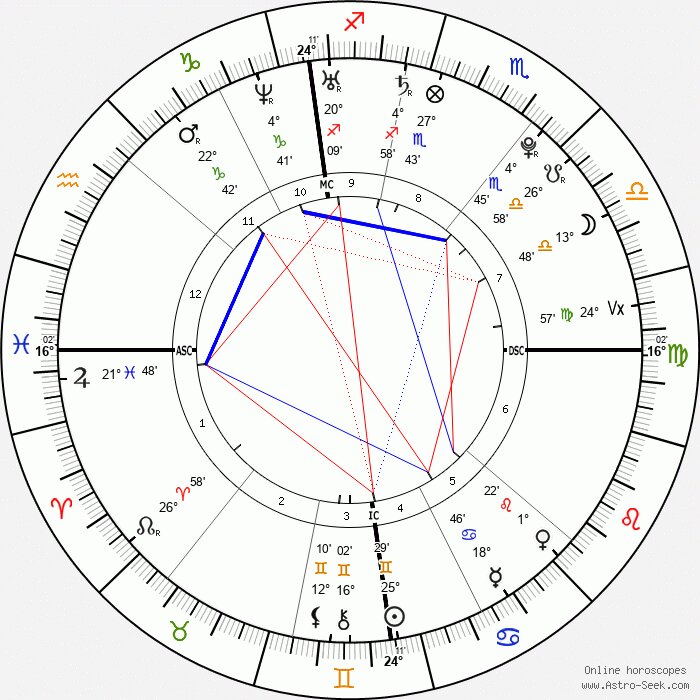
Knowing your Ascendant sign is essential because it determines your chart ruler. The planet that rules the sign on the Ascendant becomes the ruling planet of the entire chart. This chart ruler holds the ego structure together. It describes how life direction unfolds.
To interpret it properly, one must examine:
- What planet rules the rising sign
- Which house that planet occupies
- Its aspects to other planets
- Its strength or weakness in sign
- Its structural role in the overall planetary pattern
For example:
- Aries Rising → Mars is the chart ruler
- Taurus Rising → Venus is the chart ruler
- Gemini Rising → Mercury is the chart ruler
- Pisces Rising → Jupiter + Neptune are the chart rulers
The chart ruler becomes a central organizing force in the horoscope. It operates like a governing authority. Some astrologers describe it as the “king” or “queen” of the chart, while any strongly placed 1st house planet may function as a kind of prime minister, highly visible and active.
Transits to the Ascendant and Chart Ruler
Transits to the Ascendant itself are powerful turning points. When outer planets cross the Ascendant, life direction visibly shifts. Identity, health, appearance, and personal focus can undergo change.
Even more significant are transits to the chart ruler.
Because the chart ruler governs the structure of the ego and personal trajectory, transits to that planet often coincide with major developments. Saturn transiting the chart ruler can bring responsibility, consolidation, or pressure. Jupiter transiting it can expand opportunity. Uranus can disrupt established identity. Pluto can restructure the core of self-definition.
Without knowing the Ascendant, one cannot properly identify the chart ruler. And without understanding the chart ruler, major life transits may be misinterpreted. The Ascendant is therefore not optional knowledge. It is structural knowledge.
The Eastern Horizon
The Ascendant is the eastern angle of the chart. It marks sunrise, the moment light begins to emerge.
Its opposite point, the Descendant, marks sunset and partnership. But the Ascendant remains the starting point. It is the first breath, the first orientation toward the world.
Whether one views it as the physical body, the emerging ego, or the spiritual entry point into incarnation, its significance cannot be reduced to appearance alone.
The Ascendant is the beginning of the story. The chart ruler determines how that story unfolds. And when transits activate either, life rarely remains the same.